Process towers and pipe racks at a refinery under a clear sky

Services

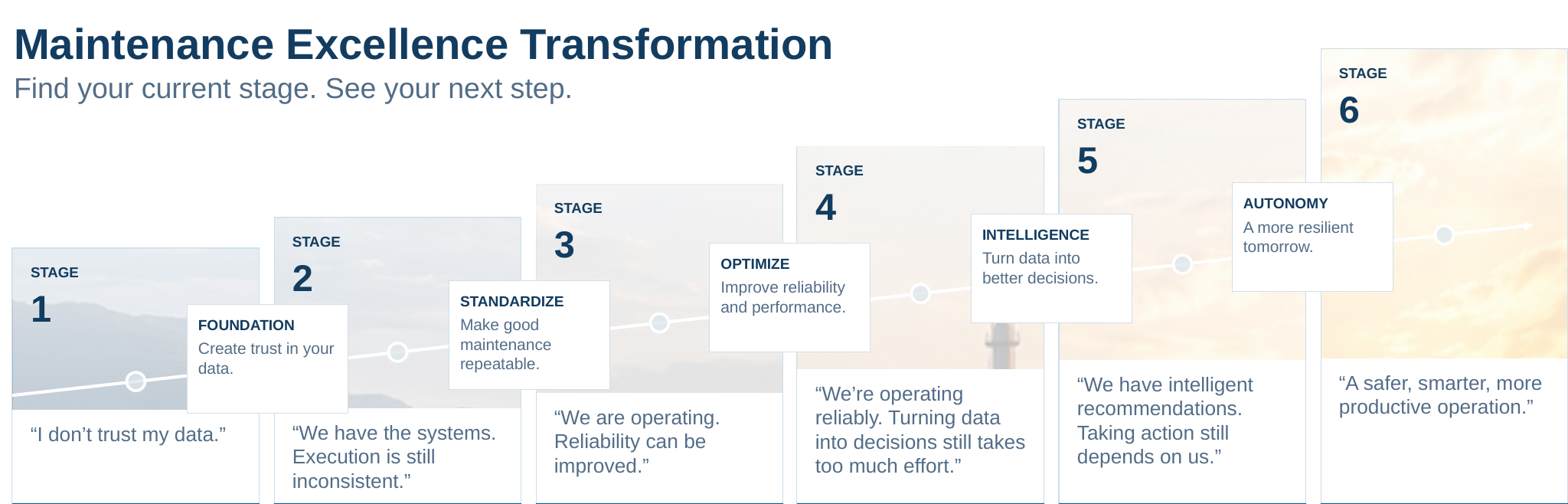
Maintenance Excellence Transformation

2E helps you understand your facility’s current stage of maintenance excellence. Our team works with you to identify priorities and tailor your transformation to the needs of your operation, its systems, data, and people.

Maintenance Excellence Transformation: six stages connected by foundation, standardization, optimization, intelligence, and autonomy.
Maintenance excellence capabilities, aligned with stages 1 through 6 in the roadmap
Area of workStage 1Stage 2Stage 3Stage 4Stage 5Stage 6
Control incoming work and prioritiesEstablish backlog and basic controlsPlanning, weekly scheduling, job plansCapacity, constraints and schedule optimizationAI co-planning, co-scheduling and decision supportAutonomous workflow orchestration
Identify critical equipmentAsset hierarchy, register and criticalityBOMs, materials and failure codingGoverned, continuously improved master dataConnected, machine-readable asset contextAutomated reconciliation, enrichment and data maintenance
Protect critical equipmentEstablish baseline PM coverageCriticality-based maintenance strategiesRCM, PM optimization and bad-actor eliminationPredictive and prescriptive strategy optimizationDynamic strategies that adapt to risk and operating state
Respond to failuresCapture meaningful equipment historyRCA and repeat-failure eliminationCondition monitoring and reliability engineeringAI-assisted diagnosis, prediction and failure analysisAutomated detection, decision and intervention
Establish a system of recordClean and configure CMMS / EAMIntegrated workflows, controls and governanceConnected operational data and analyticsGoverned AI agents and decision automationClosed-loop digital operations
Primarily manual executionStandardized paper proceduresDigitally supported field workConnected-worker and sensor-assisted executionMachine vision, remote inspection and intelligent field supportRobotics and autonomous inspection

Scroll to view all six stages.

Maintenance Excellence Transformation

Find your current stage. See your next step.

Maintenance excellence stages down the left, work areas across the top
StageWorkmanagementAsset &Materials dataEquipmentstrategyReliabilitySystems &governanceField execution& inspection
Stage1

FOUNDATION

Create trust in your data.

Control incoming work and priorities
Identify critical equipment
Protect critical equipment
Respond to failures
Establish a system of record
Primarily manual execution
Stage2

STANDARDIZE

Make good maintenance repeatable.

Establish backlog and basic controls
Asset hierarchy, register and criticality
Establish baseline PM coverage
Capture meaningful equipment history
Clean and configure CMMS / EAM
Standardized paper procedures
Stage3

OPTIMIZE

Improve reliability and performance.

Planning, weekly scheduling, job plans
BOMs, materials and failure coding
Criticality-based maintenance strategies
RCA and repeat-failure elimination
Integrated workflows, controls and governance
Digitally supported field work
Stage4

INTELLIGENCE

Turn data into better decisions.

Capacity, constraints and schedule optimization
Governed, continuously improved master data
RCM, PM optimization and bad-actor elimination
Condition monitoring and reliability engineering
Connected operational data and analytics
Connected-worker and sensor-assisted execution
Stage5

AUTONOMY

A more resilient tomorrow.

AI co-planning, co-scheduling and decision support
Connected, machine-readable asset context
Predictive and prescriptive strategy optimization
AI-assisted diagnosis, prediction and failure analysis
Governed AI agents and decision automation
Machine vision, remote inspection and intelligent field support
Stage6
Autonomous workflow orchestration
Automated reconciliation, enrichment and data maintenance
Dynamic strategies that adapt to risk and operating state
Automated detection, decision and intervention
Closed-loop digital operations
Robotics and autonomous inspection

Digital Transformation Consulting

Current-state assessment, target architecture, use-case selection, transformation roadmaps, implementation governance, and acceptance criteria.

  • Current-state assessment across systems, data, workflows, roles, and controls
  • Target architecture across CMMS/EAM, ERP, condition data, documents, automation, and AI
  • Use-case selection against operating value, feasibility, risk, and data readiness
  • Transformation roadmaps with system, data, process, and workforce dependencies
  • Implementation governance, decision rights, acceptance criteria, and transition controls
  • Software and infrastructure option evaluation without dependence on one vendor

System Setup, Migration & Data Modernization

CMMS and EAM setup and migration, system integration, data governance, cutover, validation, and maintenance-data modernization.

  • CMMS and EAM configuration, data mapping, migration, cutover, and validation
  • Integration across maintenance, purchasing, ERP, document, and condition systems
  • Data ownership, governance rules, exception handling, and controlled write-back
  • Asset Register Development from reconciled drawings, equipment lists, and system records
  • Item Master, materials, and BOM modernization to a governed cataloguing standard
  • PM Strategy Optimization through criticality, task selection, interval justification, and work packaging

AI Enablement, Automation & Predictive Maintenance

Enterprise AI environments, workflow automation, predictive maintenance, governance controls, custom skills, training, and private infrastructure.

  • Enterprise AI data integration with role-based access, audit history, and source traceability
  • Governance infrastructure, evaluation gates, human approvals, and data and AI safety controls
  • Control-center and agent-dashboard bring-up for workflow, risk, and performance oversight
  • Custom agent harnesses, organizational skills, prompts, and maintenance procedures
  • Condition-data integration, predictive-maintenance workflows, and failure-pattern analysis
  • Employee training in tool use, prompt engineering, skill maintenance, and safe review
  • On-premises AI clusters where the organization requires full data sovereignty

Custom Software & AI Bring-up

Role-specific oil and gas applications and AI workflows, integrations, interfaces, validation, deployment, documentation, and lifecycle support.

  • Workflow and system requirements defined with the people who own the operating decisions
  • Role-specific oil and gas applications for maintenance, reliability, and operations work
  • APIs, connectors, data pipelines, and interfaces to systems already in place
  • Prototype, test, validation, deployment, and controlled production transition
  • Performance, observability, access, audit, and failure-handling requirements
  • Operating documentation, training, change control, and lifecycle support

2E AI Suite

Customizable AI Empowered Workflows

The following previews introduce three 2E AI Suite workflows developed in-house for maintenance and enterprise work. Each can be configured around an organization's systems, data, permissions, and operating model.

Maintenance foundation

The existing system has to support the transformation.

AI cannot correct missing equipment records, duplicate materials, incomplete bills of material, or inconsistent failure history by itself.

Anyone who says AI can be installed on an existing operation without first assessing whether its data and workflows can support it is either naive about oil and gas systems or lying about the work that will be required.

Where the foundation needs work, 2E modernizes the maintenance records and controls before a migration, automation, or AI workflow depends on them.

Read why automated systems need cleaner data
  • Asset Register Development

    Functional-location hierarchy design, source reconciliation, naming standards, criticality, parent-child structure, and duplicate-record control.

  • Item Master & Materials Management

    Manufacturer and OEM part numbers, vendor cross-references, specification data, BOM-to-asset linkage, catalog governance, and stocking strategy.

  • PM Strategy Optimization

    Criticality assessment, RCM-based task selection, interval justification, task rationalization, work packaging, and material requirements.

Markets

Markets

  • Midstream
  • Downstream & petrochemical
  • LNG

Tell us what the operation needs to change.